Tone Report Weekly: Understanding Speaker Efficiency
Here's a piece I wrote for Tone Report Weekly on speaker efficiency and getting the most (or least) out of your guitar amp.
Showing posts with label guitar. Show all posts
Wednesday, February 12, 2014
Wednesday, February 5, 2014
Monday, August 5, 2013
Review: Eminence 820H Speaker
A few months ago, I lucked into a 1965 Fender Vibro Champ at a yard sale. It was in great condition. Heck, it still had the original tubes, caps, and speaker (along with a two-prong plug).
The first thing I did was pull the original tubes and put them away for safe keeping. Next, I sent the amp in for a three-prong plug and cap job. Finally, I put the original speaker away for safe keeping and installed the new Eminence 820H.
Like the Eminence Cannabis Rex (which I loved in my Reverend Goblin 1x12) the 820H features a hemp cone. It also sports a 1” voice coil and a 15 oz. ceramic magnet. I don’t know what the magnet in the stock speaker weighed, but the 820H is significantly more substantial.
I installed the 820H and prepared to rock out. But I was not prepared for the tone that was about to erupt from my little Vibro Champ. The 802H is rockin! This little 8” speaker plays and sounds like a 10. I plugged in my Malden Mozak (think tele) and got lost for about an hour just playing Heartbreakers songs and other “rootsy” stuff. Then I plugged in my Reverend Roundhouse (think LP) and cranked the volume further and had some fun with lead lines.
With a sensitivity rating of 96.1 dB, I wasn’t expecting a huge jump in volume. But the stock speaker must have been extremely inefficient because I have a ton more volume on tap now. But more than added volume, the tone is much big and bolder. The stock speaker started to fall apart when the volume was pushed beyond 4 and couldn’t handle any fuzz or OD pedals. With the 820H in there, I can crank the amp up all the way and the speaker can handle it. And if I didn’t need cleans, I could probably keep up with a drummer.
It stands up to pedals much better now as well. I can now slam the Vibro Champ with my Klone or use a Fuzz Face to great effect. It’s crazy how the speaker upgrade transformed the Vibro Champ from my little practice amp into a legitimate “grab and go” combo.
The Eminence 820H is just an all around amazing speaker. It has the warmth and “smoky” highs of the Cannabis Rex, great, rich mids, and amazing low-end for an 8” speaker. Bottom line: if you are looking for an 8” speaker, I can’t imagine a better option.
Monday, June 3, 2013
Lovepedal Acquires Hermida Audio?
For those of you that have been following the troubles with Hermida Audio, it looks like there is light at the end of the tunnel. Lovepedal is now the sole manufacturer, global distributor, and retailer for Hermida Audio Technology products.
"I have known Alfonso for many years. He has always had an ear for great guitar tone and a passion for engineering some of the most sought after products in the guitar industry. His goal is to replicate as close as possible the dynamics and frequency response of the tube sound and then engineer products accessible to everyone from the bedroom player to those playing in front of thousands of fans. His products and engineering chops are legendary: the Zendrive, Zendrive2, Tiki Drive and Reverb to his full set of compact speaker cabinets in both ported and open back configurations. His customer list includes some of the most demanding musicians out there." Sean Michael – LovePedal
You can sign up here to get in line for the first batch. It will be very interesting to see how people feel about the original Zendrives vs. Lovepedal versions. My advice would be to hang onto your original Zendrive. You might have the next Klon-style flip on your hands.
Thursday, April 25, 2013
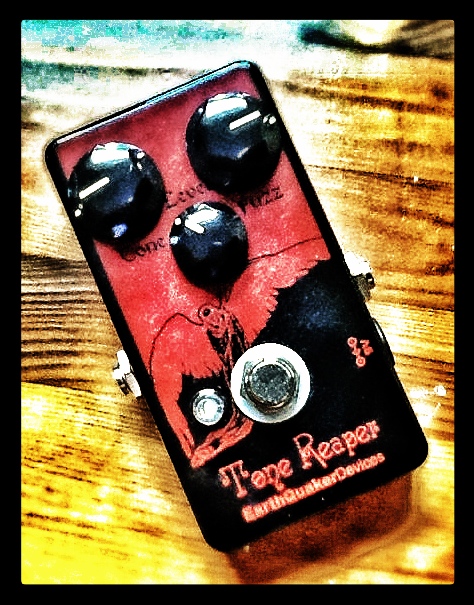
Review: Earthquaker Devices Tone Reaper
The Earthquaker Devices Tone Reaper is a silicon/germanium hybrid based on the three-knob Tone Bender. If you are looking for Jimmy Page tones, you can find them in the Tone Bender. You can also nail many of the Black Keys thickfreakness tones.
I’ve played a ton of Tonebenders over the last few years. Some have been outstanding, others have been horrible. The Tone Reaper is the best of the three knobbers. Like every Earthquaker Devices pedal I have encountered, it’s amazingly low-noise considering the amount of gain on tap. I don’t know how they make such dynamic (and ragged and raging if you want) fuzz pedals and yet keep them hum/hiss/squeal-free. Whatever they do, it’s working.
I tried the Tone Reaper with a few different guitars. I liked it with humbuckers and especially with a tele bridge pickup. But I LOVED it with P90s. Running my Reverend Ron Asheton into the Reaper and then into my Reverend Goblin (modified to a 1x12 with a Cannabis Rex) was thick and nasty, with borderline endless sustain. The Tone Reaper seems to just love P90s. It latches on to those snarling mids and wraps them in gritty fuzz that’s bright but not piercing. Low notes compress and bloom and high notes ring out. The subtleties of neck, middle, and bridge pickups shine through the fuzz and provide a broad range of tones. Most Tone Benders won’t clean up like a Fuzz Face, and the Tone Reaper is no exception. But backing off the volume slightly provides a few more shades of dirt.
Like the Dirt Transmitter, the Tone Reaper is another fuzz that can do cool things with an overdrive (TS and Klone in my case) preceding it. Setting the fuzz at about 1 o'clock makes for a pretty thick fuzz that's still touch sensitive. Hitting the Tone Reaper with a Cusack Screamer set for minimal drive, tone at noon, and output just above unity adds some extra mids to the Tone Reaper without drastically changing the overall tone. It's great for making leads jump out of the mix.
All said, the Tone Reaper is great. If you're looking for one pedal that can span the range of Tonebenders, or just looking for a new flavor of fuzz, you need to check out the Tone Reaper.
Friday, April 5, 2013
Cusack Screamer Fuzz V2
Thanks to the Cusack Screamer Fuzz, I can get Satisfaction even while I Hate it Here. I can also get a Cold Shot and a whole slew of other classic and new tones! This pedal serves up a ridiculous amount of versatility for a small yellow box with three knobs and a three-way switch.
Controls
Level: Controls the overall output of the pedal
Fuzz: All the way counter-clockwise is no fuzz. All the way clockwise is a gated and ripping sound that cuts out as the note fades.
Scream: Controls the gain of the “Screamer” circuit. All the way cranked is double the gain of your typical TS.
Clip Mode: Left is standard TS clipping, all the way right is “crushed,” and in the middle is asymmetrical LED clipping (that’s right asymmetrical like the good old Boss SD-1).
I tested the Screamer Fuzz mostly through my Reverend Goblin (quite the coincidence since Cusack now owns the rights to the Reverend amps) with a bunch of guitars. Even with the lack of a tone knob, the Cusack sounded great with single coils, P90s, humbuckers. I was worried about the lack of a tone control at first, but the Cusack is voiced perfectly. It cuts through a dense mix without ever getting shrill and somehow manages to leave each guitar sounding like itself.
We’ll start off with the fuzz all of the way down. With the switch to the left, you have a classic TS circuit. The gain range is huge and it responds well to playing dynamics and adjustments to the guitars volume control. In fact, all of the clipping options are dynamic. Running my Strat into the Screamer at these settings coaxed all of those SRV riffs I learned back in high school to my fingers and brought a big smile to my face. I don’t usually like the combination of humbuckers and TS pedals. It seems like they both accentuate the same midrange and the sound ends up kind “honky.” And while I still didn’t love a bridge humbucker paired with the Screamer Fuzz, the neck and middle position were rich with a nice vocal quality.
Switching to the middle position on the clipping selector is where I fell in love with the Screamer Fuzz. The output rises significantly over the other clipping positions and the harmonics it adds/emphasizes are just beautiful. With the gain about between 1/3 and 2/3 up, you get a break-up that responds (and sounds ) like a great tube amp. It adds the kind of compression that makes it easier to play without killing your dynamics. You pick lightly for bright cleans and dig in for some grind.
And then you start adding the fuzz to taste. Leave the selector in the middle position, put the “Scream” at noon, and the “Fuzz” at 9 o’clock. This sound alone is worth the price of admission. With my Jazzmaster, this had me rocking out to Hate in Here by Wilco. And it sounded amazing. Switching over to my Reverend Roundhouse (with humbuckers) and rolling down the volume on the guitar gave me a tone that remind me of the great edge of breakup tones on the Alabama Shakes record. I have no idea what the Shakes used for that album, but I was having a blast playing their songs at this setting. In fact, this is where I’ve left the Screamer Fuzz. And I can’t stop using it. My band is used to me having new dirt pedals frequently - to the extent that they barely pat attention to my “little habit” these days. But last week, when I stepped on the Screamer Fuzz for some lead work, they took notice.
And I know a lot of folks are “weirded out” with the LED always being on with the Cusack pedals (green in bypass and red when engaged). I’m fine with it, but if you don’t like it you can set the pedal for “legacy mode” which has the LED on only when the pedal is on. Just hold the switch down for a few seconds (until the LED blinks once), this puts the pedal into "Legacy mode.” The LED will be OFF in bypass, and RED while on. Just hold it again to put back in "Cusack" mode.
In short, the Cusack Screamer Fuzz is a blast. You can dial back the fuzz and rock some classic TS tones, crank the fuzz for gnarly fuzz tones, and/or rock a hundred shades of tone in between. Try it. You'll like it.
Friday, February 1, 2013
VFE White Horse Junior Review
I’ve been rocking a VFE White Horse Junior Optical Compressor for a few weeks and it’s without a doubt my favorite compressor. I’d call it the best compressor I’ve ever used, but pedals are subjective and I’m sure someone will feel differently.
What I love most about the White Horse Junior is that it’s simple, versatile, and transparent (if you want it to be). Sure, it will squash with the best of them, but it will also apply the perfect amount of compression to sweeten your tone, even out your playing dynamics, and just make you sound better. You can set it where you don’t hear it when you turn it on, but you feel it when you turn it off.
With just three controls, the White Horse Junior is super easy to dial in:
SUSTAIN: Controls the gain/sustain of the optical compressor
BLEND: Blends between the uncompressed and compressed signals
LEVEL: Controls the output volume of the White Horse Junior
The White Horse has a ton of compression available, so resist the urge to crank the sustain knob (or at least experiment with different levels). I’ve been running mine with the Blend control at 11 o’clock and sustain at 10 o’clock. This setting is great for clean and consistent rhythm playing (especially jangly and sustaining arpeggios).
And while I normally only have a comp on when I’m playing clean, I can leave the White Horse Junior on when I kick on the fuzz and/or overdrive and it’s quiet enough that the noise floor doesn’t go through the roof. And paired with some dirt, the White Horse Junior makes it really easy to get sweet, controllable feedback at lower volumes.
I have one of the plain metal box juniors with hand written labeling. But VFE is preparing to take the Junior pedals mainstream and are running a Kickstarter campaign as we speak. In fact, if you act quickly, you can get a White Horse Junior for $80 by supporting the campaign.
What I love most about the White Horse Junior is that it’s simple, versatile, and transparent (if you want it to be). Sure, it will squash with the best of them, but it will also apply the perfect amount of compression to sweeten your tone, even out your playing dynamics, and just make you sound better. You can set it where you don’t hear it when you turn it on, but you feel it when you turn it off.
With just three controls, the White Horse Junior is super easy to dial in:
SUSTAIN: Controls the gain/sustain of the optical compressorBLEND: Blends between the uncompressed and compressed signals
LEVEL: Controls the output volume of the White Horse Junior
The White Horse has a ton of compression available, so resist the urge to crank the sustain knob (or at least experiment with different levels). I’ve been running mine with the Blend control at 11 o’clock and sustain at 10 o’clock. This setting is great for clean and consistent rhythm playing (especially jangly and sustaining arpeggios).
And while I normally only have a comp on when I’m playing clean, I can leave the White Horse Junior on when I kick on the fuzz and/or overdrive and it’s quiet enough that the noise floor doesn’t go through the roof. And paired with some dirt, the White Horse Junior makes it really easy to get sweet, controllable feedback at lower volumes.
I have one of the plain metal box juniors with hand written labeling. But VFE is preparing to take the Junior pedals mainstream and are running a Kickstarter campaign as we speak. In fact, if you act quickly, you can get a White Horse Junior for $80 by supporting the campaign.
Friday, January 25, 2013
Cusack Goblin
![]() |
| Photo courtesy of Nathan Sousa |
Goblin - An insanely good 15 watt 6V6-powered guitar amp originally manufactured by Reverend Guitars. The Reverend Goblin was produced in small numbers (roughly 200) and I'm lucky to own one of those. Thanks to our friends at Cusack Music, the Goblin is back, and better than ever. The Cusack amps are hand-made in the US and built to withstand the rigors of the road.
If you haven't had the pleasure of playing a Goblin, start saving now. With wattage switchable between 5 and 15 watts and the brilliant 3-way Schizo switch, the Goblin is an amazing recording amp that has enough power on tap to keep up with a pounding drummer.
This Goblin isn't a grotesque creature. But it does offer various temperaments and abilities and delivers everything from pristine cleans to glorious power-tube distortion at less than ear-bleeding levels. I can't wait to try one out.
Thursday, January 10, 2013
Coolest. Amp. Ever!
I think I've already made abundantly clear in this blog, that I pray at the alter of Reverend when it comes to guitars and amps. But about two years ago, I came across someone selling a custom made Mojotone 1x12 cabinet designed for a Reverend Goblin. I loved my Goblin as is, and I certainly loved the light weight of the 1x10 cab with the Jensen Neo. But I was eager to push a little more air.
I got the cab, loaded my head, switched the Mojo greenback-style speaker for an Eminences Wizard that I had lying around and had my mind blown. Words can't describe how much I love this new setup.
More recently, I switched to an Eminence Cannabis Rex, and I'm in love all over again.
I got the cab, loaded my head, switched the Mojo greenback-style speaker for an Eminences Wizard that I had lying around and had my mind blown. Words can't describe how much I love this new setup.
More recently, I switched to an Eminence Cannabis Rex, and I'm in love all over again.
Tuesday, January 1, 2013
Faded Sticker - Track By Track Gear Run Down
Over the summer, my band recorded our debut album. You can find it on iTunes and Amazon. Or feel free to comment if you want an actual CD.
Being the gear head that I am, I took pretty meticulous notes on what we used for each track. For some overdubs, we did so many takes that we lost track, but here's the bulk of it.
We were lucky to record at Invisible Sound Studios in Baltimore, MD where we had a ton of vintage and boutique amps to choose from.And of course, thanks to my pedal addiction, we had plenty of options on that front as well.
GSRS - Reverend Roundhouse HB, into HBE Germania44, into Tweed Deluxe.
The highlight of the sessions was slamming a '58 Tweed Deluxe with an HBE Germania44 Treble Booster. Grunge is the only way to describe it. It's how we got the main rhythm tone used on GSRS.The lead guitar is a home-made 25.5 scale bolt-neck with filtertrons into the "Marshall" side of a 65 Amps London.
Mercy
For this one, the rhythm part was a Malden Mozak, into a Fulltone '69 MKII (with the volume rolled off), into a vintage Blackface Deluxe Reverb. The lead part was a 25.5 scale bolt-neck with filtertrons into one of the hand-wired AC30 reissues. The echo is a Cusack Tap-a-Delay. Even crazier, the synth and piano sounds are all from the iPad version of GarageBand.
Fireworks
I covered part of recording this song in a previous post. I discussed how I used the Cusack Tap-A-Scream to transition into the noisy coda. But the tools used for the main rhythm part were also pretty cool. Live, I've been using a Micro POG and the Leslie setting on a Line 6 M9 to do a faux B3 kind of thing. When Dave (our engineer) heard it, he said "Are you doing a rotating speaker thing there? We have a Chord-a-Vox, you know!" So we grabbed the Chord-a-Vox a fed the signal from my Reverend Goblin into it. Swirly-wirly goodness. The lead parts are the custom guitar into the '65 London.
And then the outro is a whole lot of tracks of oscillating Fuzz Factory, a theremin app, etc.
Saturday, December 29, 2012
Interview with Brian Wampler
Interview with Brian Wampler, Wampler Pedals
A few weeks ago I sent some interview questions over to Brian Wampler with the plan that he would answer via e-mail, and I would post to this blog. Brian had the great idea of doing a video interview. So Brian and his colleague, Travis sat down with the video camera and Travis asked Brian my questions.
The interview is embedded below. I don't want to spoil the fun, but I will say that I asked about his general thoughts on pedals and pedal making, what got him into it, his favorite classic (or contemporary) circuits, designs he's most proud of, and what's on the horizon. And for those of us awaiting the return of the Cranked AC, be sure to tune into the full video.
Tuesday, December 18, 2012
Review: Earthquaker Devices Organizer
| Organizer Set for Faux B3 |
With the Organizer, I can do this with just one pedal. For “faking” a B3, I liked minimizing the “Direct” guitar sound on the Organizer and using only the effected sounds (see image to left). It’s a really fun sound
Where the Organizer really shines is in providing a subtle organ pad under rhythm guitar parts. For this, I adjust the direct level on the Organizer all the way up and pull back on the “Up,” “Down,” and “Choir” levels (see image below). To try it on your own, set the controls like the pedal pictured below.
Now run a nice crunchy tone into the Organizer and through your amp. Hit some power chords. Maybe play Baba O’Riley by the Who or something in that vein? Listen to how the Organizer provides weight and a subtle thickness to your rhythm parts. It’s awesome!
Now switch off of that crunchy sound (maybe add some light compression) and play some arpeggiated stuff (I added a little delay and played some Cure and U2 songs). Listen to how the Organizer sweetens things and adds a subtle pad under your guitar. I’m loving the Organizer for playing rhythm on slower songs live (in a band without keys). It instantly makes things sound fuller and more polished (but by no means muddy or busy).
| Organizer Set as Organ Pad |
Finally, for those Black Keys fans, you can get close to the main riff from Gold on the Ceiling by running the Organizer into your favorite fuzz (I used the EQD Tone Reaper and my old Sovtek Muff). Set the Organizer with the up at noon, the down around 9 or 10 o'clock, the choir and lag at zero, the tone at 1 o'clock, and the direct at 11 o'clock.
The tracking on the Organizer is near flawless. But like any pitch shift or harmony pedal, it's important that you put a well-tuned guitar into it. If your guitar is out of tune, the Organizer can't help with the octaves.
The only complaint I can make is that there is a slight delay between striking a note and when the processed sound comes out. This isn’t a problem for organ pad sounds or mellow rhythm work. It’s a little tough for fast rhythmically intricate stuff. But it’s really short delay and by no means a deal breaker.
If you've been looking for something to add a new dimension to your guitar sound or need to fill in for an organ player on a song or two, I'd recommend the Earthquaker Devices Organizer. Now, if only they'd make a similar pedal with more of a synth pad sound. I'd pick that one up as well.
Friday, December 7, 2012
Strike at the Fuzz Factory
For years, I dreamed of owning a Fuzz Factory. So many knobs, so many great reviews, so many famous users. I mean, how could Nels Cline and Stephen Malkmus be wrong?
I recently acquired one, and while it's a hard beast to tame, there are indeed some amazing sounds waiting to be unlocked. Just be careful using it at really loud volumes until you get the hang of it (more on this later).
First, un-boxing the Fuzz Factory is a real treat. I know I shouldn't care about packaging, but when a pedal comes swaddled in a micro-fiber cloth, I take notice.
Controls
Vol: The Fuzz Factory has a ton of volume on tap. For most settings, it achieves unity gain at around 8 or 9 o'clock.
Gate: This is the control to know. It works like a noise gate, and it will save your ears when your amp is cranked and you adjust the Drive or Stab control and send the Fuzz Factory into self-oscillation.
Comp: Harder attack when turned left squishier when turned right. Gets real thin and "pinched" when turned all the way right. Works with your guitar's volume knob to tune feedback when you get crazy.
Drive: This one is easy, it controls the amount of fuzz. It goes from fuzzy to fuzzier to fuzziest. And they're all good! And it does nothing when Comp is cranked all the way.
Stab: No, this does not turn the Fuzz Factory into a weapon. It tames the beast within. Backing it off much beyond 2 o'clock on the dial gets crazy. If you're not into crazy feedback and wild oscillations, I'd keep the Stab cranked. If you like to have fun and experiment, roll this knob back and get lost in the sonic mayhem!
This pedal was a blast at home and so much fun for coming up with new parts and for recording (I used some of it's crazy sounds on the last track of my bands new album). Sure, it likes Strat and P90 pickups much more than the humbuckers in my main guitar, but no matter what, it kicked out great singing fuzz that cleaned up well when you rolled off the volume on guitar. And with minor adjustments to any of the knobs you could get a huge variety of tones. And that’s not even considering the cool oscillation noises you can get and control with your volume knob.
There's a great chart on the ZVex site with sample settings. I'd recommend taking an adhesive address label, drawing a few sets of five circles and affixing that to the front of your Fuzz Factory. You are going to come up with lots of great sounds. But the controls on the Fuzz Factory are so interactive that you won't find those same sounds again (quickly) without keeping some notes.
For my use, I came up with two main fuzz settings. One that was like a nice Fuzz Face (thick and smooth) and another with a nice upper octave effect. I then mapped out some crazier settings. There's much fun to be had at the extremes of the Fuzz Factory. But spouses, kids, pets, and neighbors will likely disagree. Oh, and if you run phase, tremolo, or some other modulation before the Fuzz Factory in oscillation mode things get even sillier. Don't blame me if you lose a few hours (or days) with this thing.
The Fuzz Factory is more fun than a barrel of monkeys. But like a barrel of monkeys, it can get out of hand quickly and make a real mess of your house. Sure there are some "safe" and classic sounds lurking inside. But the real fun comes when you tweak the knobs and it starts sounding like a tornado of fire engines and screaming banshees. That's when the magic happens.
Thursday, November 15, 2012
Interview: Dave Koltai of Pigtronix
A few weeks ago, I sat down with Dave Koltai from Pigtronix to get some background on how he got started, find out who's using Pigtronix effects, and to learn what's coming next.
P90Noir: How long have you been building?
Dave Koltai: I’ve been building since 2001. A college friend
got me started. He built an envelope controlled phase shifter from the seminal
Craig Anderton book, “Electronics Projects for Musicians.” I loved the sound of
this design and asked him to build another one for me. His nickname was
“Pigpen.” While Pigpen was constructing the second envelope phase unit for me,
I built an optical compressor from the same book, learning how to solder, and all
about the various componentry as I went along. This second envelope phase
shifter was housed in a 2-space rack, with relay based remote switching and it
never worked properly, so eventually, I had to take it all apart and then put
it back together. This rather challenging experience was my first taste of modifying,
debugging, and trouble-shooting a complex analog design.
The experience with the Anderton designed phase shifter got
me all fired up to discover more about building analog pedals. I began
researching gear online and used the wonderful resources at GeneralGuitarGadgets.com
and built many different musical effect projects. Guided by the GGG website and
my good friend, Verne Andru, I began modifying the classic designs to meet my
own needs. Eventually I had constructed a whole stable of mutant clones and was
playing through this massive pedal board of un-labeled aluminum boxes. I was
passionate about making a career in music and had found something that was
great fun, and seemed to be my calling. The rest is history.
P90Noir: Do you have
a formal training in electrical engineering?
DK: I hold a BA in Music from Middlebury College in Vermont.
I do not have an electrical
engineering degree. I do, however, have an informal training in musical
electronics, that has come from working with Howard Davis. Howard Davis designed
the Deluxe Memory Man, Deluxe Electric Mistress, PolyChorus, and many other
amazing Electro Harmonix products from their heyday in the late 70’s and early
80’s. He’s been my mentor as a designer and has been Pigtronix chief engineer
since 2005. Howard is a truly rare talent in that he creates original circuits
from scratch. Howard is absolutely brilliant and can tackle the most complex
design challenges, always bringing some unique twist to the project.
P90Noir: So where
does the design impetus come from?
DK: My role is at the crossroads of engineering and
musicianship. It’s my job that say we need to make “x, y, or z” and then
challenge Howard to design it. As a professional guitarist, I’m the guy with
the ear for tone and a sense of what is out there and what people want to buy.
I know what’s been made and where the unfulfilled sonic niches are left waiting
to be explored. Pigtronix is all about finding undiscovered territory and creating
unique products that haven’t yet been brought to market. I’ve always wanted to
make stuff that stands out and addresses unmet needs of musicians. I’ll leave
the nostalgia, retro worship and blatant cloning to others.
The design process is one in which Howard and I work together
over a period of months (or often times years) to create a product that meets
the standards necessary for production. Some of the best examples of our
collaboration in design are the amazingly fast and accurate pitch tracking of
the Mothership Synth, the unrivaled sustain of the Philosopher’s Stone and the
low-noise, high gain sounds of the Disnortion pedal. Our goal is to get the
most performance from a minimum number of parts. Our skills together make a great
combination. To succeed in the type of projects we tackle you need a creative
engineer and musician with a well-developed and informed ear.
P90Noir: Which
designs are you most proud of?
DK: All of them! To me, they are all outstanding accomplishments. As far as production volume goes, the Philosopher’s Tone has sold the most pedals to date. That effect has been adopted by many of my musical heroes. The Echolution is mypersonal favorite to use. That one is an artistic pedal which really takes the concept of a full featured delay to an extreme. It’s my “desert island pedal.” Of all our distortion boxes, I lean on the FAT Drive and Aria pedal the most– those two units are my core sound as a player.
P90Noir: What’s behind the FAT drive?
DK: CMOS (Complementary metal–oxide–semiconductor) – is the
answer. CMOS is intended for use a in digital logic circuits, but you can ram
analog audio through it to get amp-like tube sound overdrive.
P90Noir: Is the FAT Drive circuit the same as the overdrive in the Disnortion?
DK: They are similar. The Disnortion has little more bass and a little less gain, the low-end has been trimmed on the FAT Drive so that the midrange is emphasized. Most of our pedals work for bass, guitar, synths, drums or anything else. The FAT is the only one that’s really meant primarily for guitar. For the record, the FAT Drive is not even remotely related to a Tube Screamer or any other overdrive pedal for that matter. It is a unique design that represents the essence of Pigtronix, which is why we call it the FAT Drive. That pedal achieves my principal goal of being responsive to the touch of the player, letting their dynamics and touch shine through a massive wave of distortion.
P90Noir: Who’s touring and/or recording with the FAT?
DK: Brad Whitford & Joe Perry of Aerosmith tour with the FAT Drive. DweezilZappa uses it in his current live rig. David Hidalgo, Louis Perez and Cesar Rojas of Los Lobos all use the FAT Drive in their pedal boards. A lot of the time, I find out about major artists using our gear from pictures on the internet or rig rundowns in guitar magazines. It is always thrilling to know that major rockstars are BUYING my gear.
P90Noir: Can you
point to specific song where someone is using one of your pedals?
DK: “Back in the Saddle” by Aerosmith. That is Brad’s big solo when they play live and I know he is rocking the FAT Drive or Disnortion on this tune. You can hear the Mothership, when Juan Alderete from Mars Volta is shaking a stadium with sub-octaves. Richard Fortus of Guns and Roses – his main delay is the Echolution, and you hear that in most of his solos live with GnR. Josh Klinghoffer in the Red Hot Chilli Peppers has a Polysaturator on his board, but I have no idea what tunes he’s using it on. Andy Summers of the Police used the Philosopher’s Tone on “Walking on the Moon” during their last tour.
P90Noir: What do you listen to and does it impact your designs?
DK: I listen to everything. From classical music to psych rock. I love jazz, particularly Miles Davis’s classic quintets from the 50’s and 60’s. I’m a huge fan of Van Halen, Jimi Hendrix, SRV, the Who, the Police and Aerosmith. In short, I am influenced by Debussy and Beethoven as much as Bob Marley and Peter Gabriel.
As for my background, I used to perform with Kurtis Blow in a hip-hop gospel group that played weekly in the South Bronx. In that gig, I was playing with guys who were way out of my league, which is always the best possible situation to be in as it will force you to either get better or get fired. I also played Soukous and Afro Beat music with cats from the Ivory Coast, Nigeria and Ghana for several years before Pigtronix got so busy that I had to take a break from regular gigging. Now I am back to playing gigs in an all original project called the Dynamics. I try to bring all of my musical experiences to the table when designing a pedal.
P90Noir: Getting back
to the Disnortion, what are the secrets inside of that pedal? What’s the fuzz
based on? Is the Octava similar to the Tycobrahe Octavia?
DK: The fuzz is an opamp fuzz. It is Howard’s own design and not based on previous examples. For the Octava, we developed a totally original circuit that was “inspired” by the Dan Armstrong Green Ringer but uses a method of frequency doubling which results in an effect that can handle both chords and single note lines quite well. Most importantly, the Octava circuit is placed in series before the parallel Fuzz and Overdrive sections of the Disnortion. In the original Roger Mayer and Tycobrahe Octavia designs, the fuzz comes first followed by the octave doubler. In our Disnortion, the Octava portion comes first, followed by the distortion sections.
P90Noir: How did you get the idea to do parallel distortion circuits in the Disnortion pedal?
DK: It’s obvious. It’s just a good idea. You get massive distortion and gain without the noise. Its like using two amps, two mics or simply double tracking your guitar, inside a pedal. I am aware of only one other pedal on the market that does this. I am SURE there will be more in the future.
P90Noir: What’s on the horizon Pigtronix?
DK: The Infinity Looper is coming next.
It’s the first of some very ambitious pedals that we’ve been working on. It’s a
microSD card based looper pedal that records at 24bit / 48khz with tremendous
headroom, zero latency and features discreet analog limiting on the front end
as well as all analog pass-through. It’s easy to operate, yet tremendously
powerful and flexible.
The Infinity’s unique “SYNC MULTI” mode provides a
multiplier function allowing the length of Loop 2 to be 1, 2, 3, 4 or 6 times
the length of Loop 1. The loops can also be run out of sync or even in SERIES,
for verse / chorus song structures. Ninja style input split mode assigns Input
1 to Loop 1 and Input 2 to Loop 2, effectively allowing performers to record
and overdub separate instruments on separate loops, into isolated amps,
simultaneously.
The Pigtronix Infinity also provides a long awaited AUX Loop
output intended to send looped audio to stage monitors. This is especially
helpful for drummers to hear and stay in time.
P90Noir: It seems like the original Pigtronix stuff is really complex and the new stuff is simple. I mean the Philosopher’s Rock has two knobs and a switch… Why the shift?
DK: Clearly, we’re moving towards a more stream-lined approach. As I’ve gotten better at designing circuits, I’ve come to a point where the challenge is to distill the best elements of a design and put most of the decision making inside the enclosure rather than bringing every parameter out front. By expanding our line to include more simple pedals, we’re trying to give musicians options of how fancy they want to get with their Pigtronix effects, – from the two-knob Philosopher’s Rock to the eight-knob Philosopher King.
Eventually, I want to move into programmable analog designs.
Pigtronix is for the guys that want to make a new sound. You can use our pedals
to get classic old-school sounds, but you can also make new, original tones and
that is what gets me excited. It is true that we live in a digital world, but I
insist that the future can be analog even it requires that Pigs fly!
Wednesday, November 14, 2012
Interview with Steve Bragg, Empress Effects
I recently sat down with Steve Bragg from Empress Effects to talk about music, gear, robots, and the wonderful world of guitar effects. We discussed how Steve got started building effects, the "secrets" behind some of the great Empress pedals, and what's on the horizon.
P90: How long have you been building pedals and how did you get started?
Steve: I built my first pedal in high school. It was a Tycobrahe Octavia. It didn't work at all. My friends and I also tried to build a robot. We didn't get much further than the power supply. It wasn't a great start in electronics. In university I got my hands on the classic text Art of Electronics, that's when things started to make sense.
P90: Some of your pedals have pretty complex designs. What’s your background?
Steve: I took electrical engineering in university. During that time, I had a bunch of electronic projects on the go. I built a lucid dreaming inducer, which was a crappy version of the Remee (which I can't wait to get in the mail). First I designed it using logic chips on a breadboard, and it was a mess. Then I learned about embedded programming, which simplified things a lot. It also led to later putting a processor in the Empress Tremolo. Using a processor to digitally control analog circuitry makes things really interesting.
P90: The Multidrive is very cool in that it allows fuzz, overdrive, and distortion to be run in parallel. What was the impetus behind that?
Steve: The idea was pretty simple. Running dirt pedals serially kinda sucks. When you distort an already distorted sound, you end up with a mess. Sometimes that's what you want, but a lot of the time you want a thicker distortion that still responds well to your playing. Since the three subcircuits in the Multidrive are in parallel, they are each distorting the clean input. What you get isn't a mess, but a really nice thick distortion tone.
P90: Are the Fuzz, Distortion, and OD based in the Multidrive based on older circuits or are they original designs?
Steve: The subcircuits aren't based on anything directly. Jay designed the overdrive and distortion circuit from scratch. For the fuzz circuit, he employed the common trick of putting clipping diodes in the feedback path of a transistor.
P90: Which of your designs are you most proud of? Why?
Steve: I've been really happy with my current project. It's a reverb pedal that I'm working on with Jay. He's doing most of the sound algorithms, he knows a lot more about reverbs than I do. I'm working more on the architecture of the pedal. When we did the Superdelay, we were just learning how to code in C. The result was a tangled mess, picture the air conditioning systems in the movie Brazil. Trying to find bugs in the Superdelay code was miserable work. Coding the reverb has been a treat. So it's nice knowing that I'm getting better, or that I can completely delude myself into thinking so.
P90: What kind of music do you listen to mostly? Does what you listen to impact the circuits you design and build?
Steve: It's all over the place. Electronic, rock, orchestral, piano music. I used to be a lot more into rock, but I love dancing like an idiot, and nothing makes me embarrass myself like some fun electronic music, like Ratatat or Daft Punk.
As for affecting the products we build, I'm don't think it has much of an effect. I'm the least musical of our Empress team, I stay more within the realm of electronic design. I do have a couple effects that I've wanted to create for a long time that I think would be really cool. Stuff that might not sell well but hopefully helps really creative people push different ideas.
P90: You guys have some pretty big names using your pedals these days. Can you point to any songs where you know someone used an Empress pedal on a specific part?
Steve: There's a song on The Black Keys Brothers album that I'm sure has the Superdelay throughout.
P90: What’s on the horizon for Empress? Any new pedals we should keep an eye out for?
Steve: Ever since we released the Superdelay, we've had a lot of players say "The Superdelay is great, but I spend most of my time in the tape delay setting." So we've taken the tape delay mode from the Superdelay and put it inside its own pedal. Sounds just as good as the one in the Superdelay, but there's a bunch of extra features. The dry signal is all analog, there's presets if you want to use them, you can control the tempo with tap or knob, it's smaller, and uses less current. And it's $250. That's in production right now and should be ready within a month.
Also in production is our buffer and buffer+. Unlike most buffer pedals, these ones are designed specifically to be the input to and output from your pedalboard. So they provide a large input impedance for your guitar, so it doesn't get loaded down, and a low output impedance for your amp. The buffer+ has a bunch of interesting features: a stompswitch activated boost circuit, an input loading circuit to control exactly how much you want to load down your guitar, an noise filter to help with your noisy pedals, and a tuner out. You can also mute your normal output easily when tuning. The buffer pedals should also be ready within a month.
P90: That’s it for me. Do you want to add anything in closing?
Steve: Thanks for all the great questions! I'd just add that if anyone wants to get in touch with me, especially customers with questions about their pedals, they can reach me at steve@empresseffects.com.
Friday, September 14, 2012
Review: ZVex Mastotron
Never has the name of a pedal more accurately described its sound. The Mastotron is a gigantic, prehistoric, hairy beast! And I mean that in the best way possible. With five knobs and one three-way switch, it has all of the tweakability of the Fuzz Factory without any of the unpredictability. It can go from a wall of fuzz to a quest of 8-bit video game synth sounds to a a medium overdrive to the meanest thickest bass fuzz you have ever heard.
The fuzz, tone, and volume knobs are self explanatory. It’s the other two knobs and the three-way switch that hold the keys to the Mastotron magic. First, about that three-way switch, it’s labeled “subs,” and it controls the amount of low frequencies. Setting it on 3 will rattle the fillings out of your teeth, 2 is a nice middle ground, and 1 removes most of the low-frequencies and leaves you with a thin and cutting tone. The knob labeled “PW” stands for pulse width, all the way left is traditional square-wave fuzz, turned to the right is narrow pulses (the secret to those Nintendo tones). Finally, we have the knob for Relax/Push. This one adds source impedance to the incoming signal and “should be set fully clockwise when using passive pickups.”
Word on the street is that the circuit inside the Mastotron is very similar to the Wooly Mammoth. And I know that Jim James from My Morning Jacket is a big user of the Wooly Mammoth. I can tell you that using the settings in the picture above I was able to rock the lead part to Holdin’ On To Black Metal with a huge smile on my face. With these settings, you have a really rich and versatile fuzz tone that combines the best elements of a few classic fuzz pedals. It has the smoothness of a Muff, the wooliness of a good fuzz face and the attack and decay of a tonebender. Slight adjustments of the fuzz, PW, and tone knobs brings you varying degrees of those sounds.
Let me be clear though, it doesn’t sound like any one of those pedals. It’s more like throwing the three of them in a blender and playing through the results. Or maybe multi-tracking through each of them in parrallel and then blending the three together. It’s a best of all worlds fuzz tone.
But all of that is with the “normal” settings. Start moving the subs switch to the right or left and cranking the dial on the pulse width and you’re opening up a new world of fuzz tones. And that’s even before using (abusing?) the Relax/Push control.
I don’t know why the Mastotron brings out the dental analogies for me, but it does. Setting the subs at 1, the fuzz and tone full up, and the PW all the way to the right makes a sound that is like a dentist drill. It’s not a pretty sound, but it is effective for a part that you want to stand out in a mix. Leaving all settings the same and switching the subs to 3 brings us into serious video game territory. Using the neck pickup and rolling off the tone knob on my guitar had me rocking out to the Super Mario Bros. theme.
So there you have it, many flavors of fuzz in a small package at a pretty reasonable price. It's hard to go wrong with this one.
Wednesday, September 5, 2012
Review: Cusack Effects Tap-a-Scream
What is it? It’s the mutant offspring of a tremolo and an overdrive pedal with variable fade in on the overdrive. It has tap tempo, 24 waveforms and controls for depth, color, and feedback.
The Controls:
Rather than detail them here, you should just read the descriptions in the manual on the Cusack website. I’ve barely scratched the surface of what this thing can do.
The Sound:
For me, the beauty of this pedal lies in its uses as a song writing tool and for “ambient” and “sound collage” rhythm playing. Here’s an example of how I used it. My band is working on our first album (I say that lightly - we're dad-rockers with day jobs). But on one of my songs, the ending is supposed to dissolve into chaos. It’s a straight ahead rock song and then in the coda, it sort of explodes. I recorded a few tracks of feedback, oscillating delay, and synth arpeggiator and slowly faded those in. The problem was that in the context of the song, they came out of nowhere. By doubling the main rhythm guitar part with the Tap-a-Scream doing an almost reverse tremolo sound, I was able to slowly build the chaos. I now have the Tap-a-Scream guitar entering at the start of the coda and then I slowly fade in the other tracks. It's perfect for segueing from the traditional rock sound of the verses and choruses into the noisier Sonic Youth/Wilco sound of the coda.
I'm also a big fan of the Sparkledrive and the Pork Loin where you can blend your clean and dirty sounds. With the Tap-a-Scream, you can have a clean sound with dirty tremolo pulses on top. I dialed in one sound that reminded me of How Soon is Now by the Smiths. I think I sat in my basement and played a four chord progression for about fifteen or twenty minutes just listening to how the pulses emphasized different notes. It's been a great songwriting tool in that way. Each time I dial in a new sound, I come up with an interesting part to go with it.
I know I often end my reviews with a “go buy it” type line. For this one it’s not as cut and dry. I’m really enjoying this pedal. And it has led to me coming up with some really cool parts that I otherwise would not have written. As a songwriting and recording tool, it’s great. But I don’t know if I would use it in a live setting. If you’re a tinkerer and love to get to know the ins and outs of a pedal, this one will provide hours of fun for you. If you are a “set it and forget” type or a traditionalist, you might want to skip this one.
Wednesday, August 29, 2012
Review: Cusack Screamer Fuzz Bass
A few weeks ago, I picked up the new Cusack Effects Screamer Fuzz Bass. The first thing I noticed when I removed it from the box is the build quality (and sense of humor) of Cusack.
The Look
It’s well known that Cusack make their mini chickenhead knobs in house. What’s cooler though is that they paint their pedals and then use a CNC machine to cut/carve the graphics and even the serial number into the pedals. About that sense of humor: there is a large-mouth bass cnc’d into the Screamer Fuzz Bass enclosure. Bass. Bass. Get it?
The Controls
Level: This controls the output level of the pedal.
Fuzz: This controls the amount of fuzz. All the way left is no fuzz, all the way right is heaven/armegeddon (depending on your feelings on fuzz)
Scream: Left is zero gain, right is a ton!
Clip Selector: This allows you to select either the Standard, Crushed, or Assymetrical LED clipping. I liked crushed for guitar and standard for bass.
The Sound
I’m a guitar player. So the first thing I did with the Screamer Fuzz Bass was to plug my Reverend Roundhouse HB into it and run that out to my Reverend Goblin through a 12’ Eminence Wizard. I set the scream at 9 o’clock, the fuzz around 4 o’clock, and set the level for unity gain. I hit an A power chord and was rewarded with a thick gritty fuzz. There’s something in the fuzz that reminds me of a muff, but the articulation, mids, and note decay sound and feel more like a Tonebender. According to the fine folks at Cusack, the Screamer Fuzz Bass features a new custom circuit built around an op amp. Whatever it is, it sounds great. I spent the better part of the next hour riffing through the Screamer Fuzz Bass. Your Touch by the Black Keys was especially fun to play through it. And it sounded great on some Siamese Dream era Pumpkin riffs.
Later in the week, the Screamer Fuzz Bass came to band practice with me. I used it on a few songs and was impressed by the combination of low-end and cut. It’s a great sound for low-string riffing and power chords but it still works well for leads. Rocking it on a song we call GSRS (Grungy Stoner Riff Song) it sounded like Seattle circa the early 90’s – sludgy and thick with sustain for days.
Next, I handed it over to our bass player and had him rock some fuzz bass for a few songs. Aside from making our drummer cringe (he’s a bit of a traditionalist) it was a hit. It’s amazing how well it keeps the low frequencies intact without resorting to blending in the clean signal. The only other pedal I have heard do this is the Zvex Mastotron (which I happen to have on hand for a review as well).
And boy does the Screamer Fuzz Bass have a lot of volume on tap. In the switch from me to the bass player, one of us must have bumped the level knob up. When our bass player stepped on it, the walls rattled and it felt like the ceiling was going to cave in. I can’t imagine a time when a bass player would need that much boost, but it excels at slamming the front end of a amp.
Dialing back the fuzz and using just the overdrive sounds great on bass and would be great for adding emphasis for a melodic bassline. The overdrive alone was less thrilling to me on guitar (but that’s not it’s stated purpose).
The other thing to point out is just how noise-free the circuit is. For having this amount of gain on tap, it’s amazing how little noise it adds with the gain cranked. I couldn’t hear any added noise with humbuckers.
I can't find a weakness in this pedal. If I had to find a weakness, it would be that the fuzz doesn’t clean up with the volume knob on your guitar. The overdrive section cleans up beautifully when you roll off your volume knob though, so I'm really just splitting hairs at this point.
If you play bass and like fuzz, you should buy (or at least try) the Screamer Fuzz Bass asap. If you play guitar and are looking for something with it’s own sound but somewhere crossed between a Tonebender and a Muff, check it out. It sounds great, is dead silent, and is built like a tank!
Interview: Tom Dalton, FuzzHugger
P90Noir Interview with Tom Dalton, FuzzHugger(fx)
P90Noir: How long have you been building pedals and how did you get started?
Tom: First, I've got to say, hi and thanks! And that P90s happen to be my favorite pickups. Most of my pedals were designed and tested on P90s.
I've been building pedals for...12 years? I started small and slow, with bypass / signal-routing boxes, really just out of personal need, or bandmates' needs—it was a long time before FuzzHugger came into being. But even though things have really grown, at the end of the day, it's still me painting and wiring pedals. (Though I've got to thank Laura Bennett and Pat Corrigan for painting some FuzzHugger pedals, Inga for shipping and moral support, and Pete for working on some new circuits.)
P90Noir: Fuzz seems to be your forte, what is it about fuzz pedals that you like so much?
Tom: My search for the perfect fuzz was what got me into pedals in the first place. And even though fuzz is just a niche in the overall pedal world, fuzz fans flock together...I think partly because there's a lot to talk about! I'm not sure you could have a whole message board dedicated to delay love (and if there were/is, I imagine there would be 2-3 factions all debating the merits of 3-5 hot delays). There seems to be more set rules about what people want in a delay (it needs to have at least X amount of delay time, or needs to be darkish and analog, or needs to be pristine and perfect)...where there's a whole range of fuzz sounds, and people don't just want one or two (like delay, sticking with the example), but might want a gated fuzz, crunchy fuzz, and overdriven and sustaining fuzz, a crackly and noisy fuzz, an oscillating fuzz (and there's even a huge variety in the oscillation you can produce with different fuzzes). Fuzz covers tones from crapping-out to unbelievably harmonically rich. So there are less set rules with fuzz, what constitutes good, bad, and good-bad.
P90Noir: Which of your designs are you most proud of? Why?
Tom: The first pedal that pops into my head is the Pocket Arcade. It has five modes of all-analog octave up, octave up fuzz, octave down glitch, and controllable oscillation...and it's in a 2.37” x 4.37” enclosure (even just from a layout and switching standpoint, I'm proud of my work there). But I also have to mention the Algal Bloom and AB-Synth, as the two pedals that really kick-started FuzzHugger(fx) and are still drawing interest a few years later. I think that's because they're something different, in a Big Muff and Fuzz Face dominated market.
P90Noir: Looking at some of your pedals, it’s clear that you have an appreciation for square wave, Velcro, and more “extreme” fuzz sounds. What’s your favorite circuit (from another builder), the one that the builder got just right on the first go?
Tom: I definitely appreciate extreme sounds, but they have to be usable...not only fun, but something that can fit into people's music (there is the Magic Meter overdrive, which goes from subtle to extreme...and the Algal Bloom, that's not only a musical fuzz, but can be backed off into pretty overdrives...even the AB-Synth is more controllable—and tamable—than ever in its new v2 configuration). Part of my goal is wide-range controls: if I can make a circuit get a little extreme, I will...but if I can also add a knob to bring it totally down to earth, I'll add that too. It's almost painful for me to know that there's a great knob I could've added but didn't.
Now to your question! (Haha...people who email me can expect long answers.) This is tough, cause I've played so many pedals and have a lot of builder friends, but I'll name the first few that pop out. One is the sadly/apparently defunct Mellowtone's Wolf Computer. After a few minutes of what?!, you learn your way around the controls, and it's a really brilliant and versatile pedal. Another is the *Dr. Scientist Frazz Dazzler...it's versatile and has a really unique feel...it made me smile right away.
P90Noir: I notice that you link to the Beavis Audio statement against batteries. I for one swear that I can feel/hear a difference when using some vintage-style pedals with a battery. I’d love to kick batteries entirely but I love them for these uses. Do you feel like your pedals sound and feel the same with an adapter as they do with batteries?
Tom: First, I recommend everyone reads Beavis' page on batteries. But I think, in general, 9 volts of power equals 9 volts of power (though adapters can bring in extra noise, you can root out the problem or upgrade your adapter)...it's when the battery starts draining that the difference (to me) comes into play, because then we actually have a difference in voltage. A few of my pedals—the ones I think benefit from it—have a voltage knob. Then you can adjust from 9 volts and down. (Or if you have a 12v adapter, from 12v down!) Then, you can dial in the exact response you want in seconds, without waiting for a battery to drain.
P90Noir: What kind of music do you listen to mostly? Does what you listen to impact the circuits you design and build?
Tom: This is a tough one. I'm kind of quiet about my musical tastes, because they're so varied...and I don't want to color anyone's feelings about the genre my pedals are intended for. What I'm listening to doesn't change the pedals I build. When I'm working on a new pedal, I'm thinking cross-genre, more about the tones and usability than the style of music. But on a personal level, here's a quick taste of what I listened to most in the past year: Paul Simon, They Might Be Giants, El-P, early Weezer, the Mountain Goats.
P90Noir: Do you know of any examples where your pedals where used on a specific track by an artist? Who out there is touring with one or more of your pedals on their board?
Tom: There are so many local, regional, and semi-obscure national bands with my pedals...and I've gotta thank them first (The Boys Themselves, Starling Electric, Oh So, We Were Wolves, Dangerous Ponies, and a bunch more). There are bands out there making amazing music, and the only difference is, they're not famous (yet?). When it comes to the really famous bands, I don't want to exploit them, and I don't know what endorsement deals they might have. But several internationally famous, multi-million-record-selling bands have FuzzHugger pedals on their boards. Apart from those bands, I will mention The Long Winters and The Special Goodness, who you may not have heard of, but have been personal favorites of mine for 10 years...having them play FuzzHugger pedals was incredibly exciting for me.
P90Noir: What’s on the horizon for FuzzHugger? Any new pedals we should keep an eye out for?
Tom: The Phantom Octave is coming back, with a new graphic, and there are always new graphics and one-off finishes popping up. I don't want to say too much, but in 2013, there will be two new non-fuzz FuzzHugger pedals! And non-fuzz doesn't mean boost or overdrive, but somewhere FuzzHugger has never gone before.
P90Noir: That’s it for me. Do you want to add anything in closing?
Tom: Thanks! I'd just like to say that people are welcome to email me with any questions, and also invite people to come post on ilovefuzz.com!
*Author's note: I should be receiving in a Dr. Scientist Frazzdazzler in the next few weeks and will be posting a review. Keep an eye out!
P90Noir: How long have you been building pedals and how did you get started?
Tom: First, I've got to say, hi and thanks! And that P90s happen to be my favorite pickups. Most of my pedals were designed and tested on P90s.
I've been building pedals for...12 years? I started small and slow, with bypass / signal-routing boxes, really just out of personal need, or bandmates' needs—it was a long time before FuzzHugger came into being. But even though things have really grown, at the end of the day, it's still me painting and wiring pedals. (Though I've got to thank Laura Bennett and Pat Corrigan for painting some FuzzHugger pedals, Inga for shipping and moral support, and Pete for working on some new circuits.)
P90Noir: Fuzz seems to be your forte, what is it about fuzz pedals that you like so much?
Tom: My search for the perfect fuzz was what got me into pedals in the first place. And even though fuzz is just a niche in the overall pedal world, fuzz fans flock together...I think partly because there's a lot to talk about! I'm not sure you could have a whole message board dedicated to delay love (and if there were/is, I imagine there would be 2-3 factions all debating the merits of 3-5 hot delays). There seems to be more set rules about what people want in a delay (it needs to have at least X amount of delay time, or needs to be darkish and analog, or needs to be pristine and perfect)...where there's a whole range of fuzz sounds, and people don't just want one or two (like delay, sticking with the example), but might want a gated fuzz, crunchy fuzz, and overdriven and sustaining fuzz, a crackly and noisy fuzz, an oscillating fuzz (and there's even a huge variety in the oscillation you can produce with different fuzzes). Fuzz covers tones from crapping-out to unbelievably harmonically rich. So there are less set rules with fuzz, what constitutes good, bad, and good-bad.
P90Noir: Which of your designs are you most proud of? Why?
Tom: The first pedal that pops into my head is the Pocket Arcade. It has five modes of all-analog octave up, octave up fuzz, octave down glitch, and controllable oscillation...and it's in a 2.37” x 4.37” enclosure (even just from a layout and switching standpoint, I'm proud of my work there). But I also have to mention the Algal Bloom and AB-Synth, as the two pedals that really kick-started FuzzHugger(fx) and are still drawing interest a few years later. I think that's because they're something different, in a Big Muff and Fuzz Face dominated market.
P90Noir: Looking at some of your pedals, it’s clear that you have an appreciation for square wave, Velcro, and more “extreme” fuzz sounds. What’s your favorite circuit (from another builder), the one that the builder got just right on the first go?
Tom: I definitely appreciate extreme sounds, but they have to be usable...not only fun, but something that can fit into people's music (there is the Magic Meter overdrive, which goes from subtle to extreme...and the Algal Bloom, that's not only a musical fuzz, but can be backed off into pretty overdrives...even the AB-Synth is more controllable—and tamable—than ever in its new v2 configuration). Part of my goal is wide-range controls: if I can make a circuit get a little extreme, I will...but if I can also add a knob to bring it totally down to earth, I'll add that too. It's almost painful for me to know that there's a great knob I could've added but didn't.
Now to your question! (Haha...people who email me can expect long answers.) This is tough, cause I've played so many pedals and have a lot of builder friends, but I'll name the first few that pop out. One is the sadly/apparently defunct Mellowtone's Wolf Computer. After a few minutes of what?!, you learn your way around the controls, and it's a really brilliant and versatile pedal. Another is the *Dr. Scientist Frazz Dazzler...it's versatile and has a really unique feel...it made me smile right away.
P90Noir: I notice that you link to the Beavis Audio statement against batteries. I for one swear that I can feel/hear a difference when using some vintage-style pedals with a battery. I’d love to kick batteries entirely but I love them for these uses. Do you feel like your pedals sound and feel the same with an adapter as they do with batteries?
Tom: First, I recommend everyone reads Beavis' page on batteries. But I think, in general, 9 volts of power equals 9 volts of power (though adapters can bring in extra noise, you can root out the problem or upgrade your adapter)...it's when the battery starts draining that the difference (to me) comes into play, because then we actually have a difference in voltage. A few of my pedals—the ones I think benefit from it—have a voltage knob. Then you can adjust from 9 volts and down. (Or if you have a 12v adapter, from 12v down!) Then, you can dial in the exact response you want in seconds, without waiting for a battery to drain.
P90Noir: What kind of music do you listen to mostly? Does what you listen to impact the circuits you design and build?
Tom: This is a tough one. I'm kind of quiet about my musical tastes, because they're so varied...and I don't want to color anyone's feelings about the genre my pedals are intended for. What I'm listening to doesn't change the pedals I build. When I'm working on a new pedal, I'm thinking cross-genre, more about the tones and usability than the style of music. But on a personal level, here's a quick taste of what I listened to most in the past year: Paul Simon, They Might Be Giants, El-P, early Weezer, the Mountain Goats.
P90Noir: Do you know of any examples where your pedals where used on a specific track by an artist? Who out there is touring with one or more of your pedals on their board?
Tom: There are so many local, regional, and semi-obscure national bands with my pedals...and I've gotta thank them first (The Boys Themselves, Starling Electric, Oh So, We Were Wolves, Dangerous Ponies, and a bunch more). There are bands out there making amazing music, and the only difference is, they're not famous (yet?). When it comes to the really famous bands, I don't want to exploit them, and I don't know what endorsement deals they might have. But several internationally famous, multi-million-record-selling bands have FuzzHugger pedals on their boards. Apart from those bands, I will mention The Long Winters and The Special Goodness, who you may not have heard of, but have been personal favorites of mine for 10 years...having them play FuzzHugger pedals was incredibly exciting for me.
P90Noir: What’s on the horizon for FuzzHugger? Any new pedals we should keep an eye out for?
Tom: The Phantom Octave is coming back, with a new graphic, and there are always new graphics and one-off finishes popping up. I don't want to say too much, but in 2013, there will be two new non-fuzz FuzzHugger pedals! And non-fuzz doesn't mean boost or overdrive, but somewhere FuzzHugger has never gone before.
P90Noir: That’s it for me. Do you want to add anything in closing?
Tom: Thanks! I'd just like to say that people are welcome to email me with any questions, and also invite people to come post on ilovefuzz.com!
*Author's note: I should be receiving in a Dr. Scientist Frazzdazzler in the next few weeks and will be posting a review. Keep an eye out!
Subscribe to:
Posts (Atom)