Showing posts with label review. Show all posts

Monday, August 5, 2013

Review: Eminence 820H Speaker


A few months ago, I lucked into a 1965 Fender Vibro Champ at a yard sale. It was in great condition. Heck, it still had the original tubes, caps, and speaker (along with a two-prong plug).

The first thing I did was pull the original tubes and put them away for safe keeping. Next, I sent the amp in for a three-prong plug and cap job. Finally, I put the original speaker away for safe keeping and installed the new Eminence 820H.

Like the Eminence Cannabis Rex (which I loved in my Reverend Goblin 1x12) the 820H features a hemp cone. It also sports a 1” voice coil and a 15 oz. ceramic magnet. I don’t know what the magnet in the stock speaker weighed, but the 820H is significantly more substantial.

I installed the 820H and prepared to rock out. But I was not prepared for the tone that was about to erupt from my little Vibro Champ. The 802H is rockin! This little 8” speaker plays and sounds like a 10. I plugged in my Malden Mozak (think tele) and got lost for about an hour just playing Heartbreakers songs and other “rootsy” stuff. Then I plugged in my Reverend Roundhouse (think LP) and cranked the volume further and had some fun with lead lines. 

With a sensitivity rating of 96.1 dB, I wasn’t expecting a huge jump in volume. But the stock speaker must have been extremely inefficient because I have a ton more volume on tap now. But more than added volume, the tone is much big and bolder. The stock speaker started to fall apart when the volume was pushed beyond 4 and couldn’t handle any fuzz or OD pedals. With the 820H in there, I can crank the amp up all the way and the speaker can handle it. And if I didn’t need cleans, I could probably keep up with a drummer.

Don’t get me wrong, the Vibro Champ sounded pretty good with the original speaker. But with the 820H, it sounds bigger, sweeter, and fuller. It's funny, the 820H made the most difference at low-volume and high-volume. It now sounds richer at low volume and it doesn't fart out and fall apart when it's cranked.
It stands up to pedals much better now as well. I can now slam the Vibro Champ with my Klone or use a Fuzz Face to great effect. It’s crazy how the speaker upgrade transformed the Vibro Champ from my little practice amp into a legitimate “grab and go” combo.

The Eminence 820H is just an all around amazing speaker. It has the warmth and “smoky” highs of the Cannabis Rex, great, rich mids, and amazing low-end for an 8” speaker. Bottom line: if you are looking for an 8” speaker, I can’t imagine a better option.


Wednesday, May 8, 2013

Sushi Nari Columbia

Sushi Nari (Kings Contrivance Village Center)

There’s no excuse for why it’s taken me this long to write about Sushi Nari in Kings Contrivance. We eat there at least monthly, if not more often. In fact, last week, we ate there twice in the span of four days. It’s our go-to sushi and it’s my six year-old daughter’s self-proclaimed favorite restaurant (even if she eats only miso soup, avocado rolls, and edamame).

We mostly get carry-out, but we’ve dined in many times as well. The fish is always fresh, the presentation is great, and the service is friendly and efficient. The standard rolls at Nari are great. And we almost always order at least one tuna or tuna/avocado and one spicy tuna roll. But the specialty rolls are also great. Standouts include the Firecracker Roll (white and red tuna, rolled with sushi rice, flash fried and topped with a special sauce), the French Roll (shrimp tempura with real crab), and the Yummy Yummy (shrimp tempura and avocado inside with spicy tuna, tempura flakes, and special sauce).

The lunch special at Nari is the real hit. For $10, you get 10 pieces Nigiri (your choice), a roll of your choice, soup, and a house salad. The Nigiri pieces aren’t huge. If they were, I wouldn’t be able to eat 10 at lunch. But they are always fresh and delicious. And this way, I get a really nice variety of fish. And of course, the meal ends with Nari’s cinnamon tea.

Nari doesn’t have a website. But they have a Facebook page. And you can find their menu (and get delivery) via CarryOutMenu.com.

It was actually something my daughter said, that prompted this post. We got carry-out with some friends on Saturday and one friend mentioned that he thinks Nari is the best sushi in Columbia and that he will be heartbroken if they close. He says he’s almost always the only person in there when he gets carry-out. I’m always a little surprised at how uncrowded the restaurant is. But they seem to do good lunch business and good evening carry-out.

Either way, my daughter overheard the conversation and in the car on the way home said “I don’t want Sushi Nari to close. It’s my favorite restaurant!” So don’t break a little girl’s heart. Get out there and try Sushi Nari.  hocofood@@@

Friday, April 26, 2013

Spring Songs 2013

Spring should be about “happy” music. The first warm and sunny days always have me running to grab the Best of the Allman Brothers, REM Green, and Matthew Sweet 100% Fun and Girlfriend. Of course, buried deep under the jangling (or sliding) guitars and the sugar-sweetened melodies lie some melancholy lyrics.

So today, while listening to Dawes, Stories Don’t End and The Music is You:  A Tribute to John Denver, the combination of sweet melodies and melancholy lyrics felt perfect.

A Little Bit of Everything from the previous Dawes album, brought tears to my eyes the first time I heard it. And as long as I’m paying attention, it still brings on the water works pretty much anytime I listen to it. The only other things that can guarantee this are The Luckiest and Magic (by Ben Folds and Ben Folds Five respectively) and pretty much anything written by John Denver or Jackson Browne (at least up through The Pretender).

The Music is You: A Tribute to John Denver
For Denver, it’s the melodies and chord changes as much as the lyrics. The songs remind me of being a kid and riding with my dad in our first cassette-player equipped car. This morning, while listening to Evan Dando singing Looking for Space, my mind was pretty much blown. Worlds collided as a voice from my high school years, sang a song from my childhood with lyrics about struggling to find your place in the world as a young adult.

And then a few minutes later, I looked into the back seat as my eldest had tears in her eyes listening to Sunshine on My Shoulders. And it was Train singing it! Train! Clearly there is no greater testament to a well-written song than when a band as craptastic as *Train can turn in a compelling performance.

Clearly, I have a vested interest in this album. John Denver holds a special place in my heart and the album features contributions from some of my favorite artists. But it’s worth a listen. My stand-out tracks are Evan Dando - Looking for Space, My Morning Jacket - Leaving on a Jet Plane, and Emylou Harris and Brandi Carlise doing Take Me Home, Country Roads. My youngest daughter has been requesting that we listen to Country Roads over, and over, and over again. I can't blame her.

Dawes, Stories Don’t End
Let me be clear. Stories Don’t End was my most highly anticipated release of 2013. Sure, I was also looking forward to Iron & Wine’s Ghost on Ghost and a few other releases. But the previous Dawes album, Nothing is Wrong, is easily my favorite album of the last few years. And Taylor Goldsmith may be the best songwriter of his generation.

At first listen, I was a little let down. The album didn't have as many songs that immediately hooked as Nothing is Wrong. But the more I listen, the more I love it. I read recently that Taylor had been digging into the Willie Nelson catalog as he wrote these songs. And I think I can hear the influence. I wonder if he was also digging into Elvis Costello. There's something about Just My Luck and Side Effects that reminds of King of America and Blood & Chocolate-era Elvis Costello. It's in the phrasing, the melodies, and the chord changes. Either way, I love it. But even with hearing these influences, I hear a songwriter finding his own voice. And if he can maintain this trajectory of writing, the next few albums are going to be amazing.

But seriously, go buy this album now! If you want just a taste, check out Bear Witness, Someone Will (my favorite song of the year), and Just Beneath the Surface.


*Train, for when Nickelback is too rocking but you need to find the worst possible music out there.

Thursday, April 25, 2013

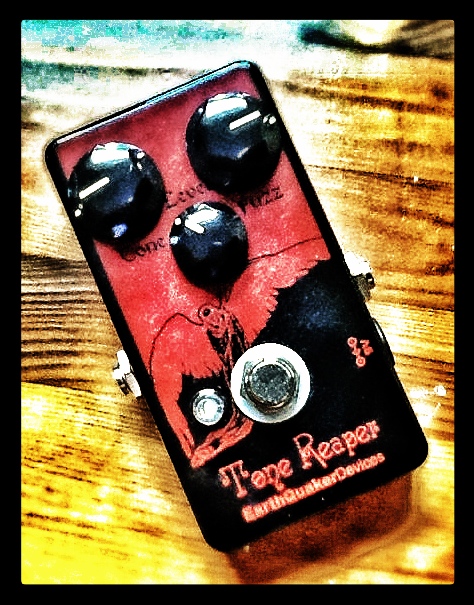
Review: Earthquaker Devices Tone Reaper

The Earthquaker Devices Tone Reaper is a silicon/germanium hybrid based on the three-knob Tone Bender. If you are looking for Jimmy Page tones, you can find them in the Tone Bender. You can also nail many of the Black Keys thickfreakness tones.

I’ve played a ton of Tonebenders over the last few years. Some have been outstanding, others have been horrible. The Tone Reaper is the best of the three knobbers. Like every Earthquaker Devices pedal I have encountered, it’s amazingly low-noise considering the amount of gain on tap. I don’t know how they make such dynamic (and ragged and raging if you want) fuzz pedals and yet keep them hum/hiss/squeal-free. Whatever they do, it’s working.

I tried the Tone Reaper with a few different guitars. I liked it with humbuckers and especially with a tele bridge pickup. But I LOVED it with P90s. Running my Reverend Ron Asheton into the Reaper and then into my Reverend Goblin (modified to a 1x12 with a Cannabis Rex) was thick and nasty, with borderline endless sustain. The Tone Reaper seems to just love P90s. It latches on to those snarling mids and wraps them in gritty fuzz that’s bright but not piercing. Low notes compress and bloom and high notes ring out. The subtleties of neck, middle, and bridge pickups shine through the fuzz and provide a broad range of tones. Most Tone Benders won’t clean up like a Fuzz Face, and the Tone Reaper is no exception. But backing off the volume slightly provides a few more shades of dirt.

Like the Dirt Transmitter, the Tone Reaper is another fuzz that can do cool things with an overdrive (TS and Klone in my case) preceding it. Setting the fuzz at about 1 o'clock makes for a pretty thick fuzz that's still touch sensitive. Hitting the Tone Reaper with a Cusack Screamer set for minimal drive, tone at noon, and output just above unity adds some extra mids to the Tone Reaper without drastically changing the overall tone. It's great for making leads jump out of the mix.

All said, the Tone Reaper is great. If you're looking for one pedal that can span the range of Tonebenders, or just looking for a new flavor of fuzz, you need to check out the Tone Reaper.

Friday, April 5, 2013

Cusack Screamer Fuzz V2

Thanks to the Cusack Screamer Fuzz, I can get Satisfaction even while I Hate it Here. I can also get a Cold Shot and a whole slew of other classic and new tones! This pedal serves up a ridiculous amount of versatility for a small yellow box with three knobs and a three-way switch.

Controls
Level: Controls the overall output of the pedal
Fuzz: All the way counter-clockwise is no fuzz. All the way clockwise is a gated and ripping sound that cuts out as the note fades.
Scream: Controls the gain of the “Screamer” circuit. All the way cranked is double the gain of your typical TS.
Clip Mode: Left is standard TS clipping, all the way right is “crushed,” and in the middle is asymmetrical LED clipping (that’s right asymmetrical like the good old Boss SD-1).

I tested the Screamer Fuzz mostly through my Reverend Goblin (quite the coincidence since Cusack now owns the rights to the Reverend amps) with a bunch of guitars. Even with the lack of a tone knob, the Cusack sounded great with single coils, P90s, humbuckers. I was worried about the lack of a tone control at first, but the Cusack is voiced perfectly. It cuts through a dense mix without ever getting shrill and somehow manages to leave each guitar sounding like itself.

We’ll start off with the fuzz all of the way down. With the switch to the left, you have a classic TS circuit. The gain range is huge and it responds well to playing dynamics and adjustments to the guitars volume control. In fact, all of the clipping options are dynamic. Running my Strat into the Screamer at these settings coaxed all of those SRV riffs I learned back in high school to my fingers and brought a big smile to my face. I don’t usually like the combination of humbuckers and TS pedals. It seems like they both accentuate the same midrange and the sound ends up kind “honky.” And while I still didn’t love a bridge humbucker paired with the Screamer Fuzz, the neck and middle position were rich with a nice vocal quality.

Switching to the middle position on the clipping selector is where I fell in love with the Screamer Fuzz. The output rises significantly over the other clipping positions and the harmonics it adds/emphasizes are just beautiful. With the gain about between 1/3 and 2/3 up, you get a break-up that responds (and sounds ) like a great tube amp. It adds the kind of compression that makes it easier to play without killing your dynamics. You pick lightly for bright cleans and dig in for some grind.

And then you start adding the fuzz to taste. Leave the selector in the middle position, put the “Scream” at noon, and the “Fuzz” at 9 o’clock. This sound alone is worth the price of admission. With my Jazzmaster, this had me rocking out to Hate in Here by Wilco. And it sounded amazing. Switching over to my Reverend Roundhouse (with humbuckers) and rolling down the volume on the guitar gave me a tone that remind me of the great edge of breakup tones on the Alabama Shakes record. I have no idea what the Shakes used for that album, but I was having a blast playing their songs at this setting. In fact, this is where I’ve left the Screamer Fuzz. And I can’t stop using it. My band is used to me having new dirt pedals frequently - to the extent that they barely pat attention to my “little habit” these days. But last week, when I stepped on the Screamer Fuzz for some lead work, they took notice.

And I know a lot of folks are “weirded out” with the LED always being on with the Cusack pedals (green in bypass and red when engaged). I’m fine with it, but if you don’t like it you can set the pedal for “legacy mode” which has the LED on only when the pedal is on. Just hold the switch down for a few seconds (until the LED blinks once), this puts the pedal into "Legacy mode.” The LED will be OFF in bypass, and RED while on. Just hold it again to put back in "Cusack" mode.

In short, the Cusack Screamer Fuzz is a blast. You can dial back the fuzz and rock some classic TS tones, crank the fuzz for gnarly fuzz tones, and/or rock a hundred shades of tone in between. Try it. You'll like it.

Friday, September 14, 2012

Review: ZVex Mastotron

Review: ZVex Mastotron

Never has the name of a pedal more accurately described its sound. The Mastotron is a gigantic, prehistoric, hairy beast! And I mean that in the best way possible. With five knobs and one three-way switch, it has all of the tweakability of the Fuzz Factory without any of the unpredictability. It can go from a wall of fuzz to a quest of 8-bit video game synth sounds to a a medium overdrive to the meanest thickest bass fuzz you have ever heard.

The fuzz, tone, and volume knobs are self explanatory. It’s the other two knobs and the three-way  switch that hold the keys to the Mastotron magic. First, about that three-way switch, it’s labeled “subs,” and it controls the amount of low frequencies. Setting it on 3 will rattle the fillings out of your teeth, 2 is a nice middle ground, and 1 removes most of the low-frequencies and leaves you with a thin and cutting tone. The knob labeled “PW” stands for pulse width, all the way left is traditional square-wave fuzz, turned to the right is narrow pulses (the secret to those Nintendo tones). Finally, we have the knob for Relax/Push. This one adds source impedance to the incoming signal and “should be set fully clockwise when using passive pickups.”

Word on the street is that the circuit inside the Mastotron is very similar to the Wooly Mammoth. And I know that Jim James from My Morning Jacket is a big user of the Wooly Mammoth. I can tell you that using the settings in the picture above I was able to rock the lead part to Holdin’ On To Black Metal with a huge smile on my face. With these settings, you have a really rich and versatile fuzz tone that combines the best elements of a few classic fuzz pedals. It has the smoothness of a Muff, the wooliness of a good fuzz face and the attack and decay of a tonebender. Slight adjustments of the fuzz, PW, and tone knobs brings you varying degrees of those sounds.

Let me be clear though, it doesn’t sound like any one of those pedals. It’s more like throwing the three of them in a blender and playing through the results. Or maybe multi-tracking through each of them in parrallel and then blending the three together. It’s a best of all worlds fuzz tone.

But all of that is with the “normal” settings. Start moving the subs switch to the right or left and cranking the dial on the pulse width and you’re opening up a new world of fuzz tones. And that’s even before using (abusing?) the Relax/Push control.

I don’t know why the Mastotron brings out the dental analogies for me, but it does. Setting the subs at 1, the fuzz and tone full up, and the PW all the way to the right makes a sound that is like a dentist drill. It’s not a pretty sound, but it is effective for a part that you want to stand out in a mix. Leaving all settings the same and switching the subs to 3 brings us into serious video game territory. Using the neck pickup and rolling off the tone knob on my guitar had me rocking out to the Super Mario Bros. theme.

So there you have it, many flavors of fuzz in a small package at a pretty reasonable price. It's hard to go wrong with this one. 

Wednesday, September 5, 2012

Review: Cusack Effects Tap-a-Scream

Why does an overdrive pedal need tap tempo? That’s a question I can hardly answer. But I can say that the Cusack Effects Tap-a-Scream is a whole lot of fun.

What is it? It’s the mutant offspring of a tremolo and an overdrive pedal with variable fade in on the overdrive. It has tap tempo, 24 waveforms and controls for depth, color, and feedback.

The Controls:
Rather than detail them here, you should just read the descriptions in the manual on the Cusack website. I’ve barely scratched the surface of what this thing can do.

The Sound:
For me, the beauty of this pedal lies in its uses as a song writing tool and for “ambient” and “sound collage” rhythm playing.  Here’s an example of how I used it. My band is working on our first album (I say that lightly - we're dad-rockers with day jobs). But on one of my songs, the ending is supposed to dissolve into chaos. It’s a straight ahead rock song and then in the coda, it sort of explodes. I recorded a few tracks of feedback, oscillating delay, and synth arpeggiator and slowly faded those in. The problem was that in the context of the song, they came out of nowhere. By doubling the main rhythm guitar part with the Tap-a-Scream doing an almost reverse tremolo sound, I was able to slowly build the chaos. I now have the Tap-a-Scream guitar entering at the start of the coda and then I slowly fade in the other tracks. It's perfect for segueing from the traditional rock sound of the verses and choruses into the noisier Sonic Youth/Wilco sound of the coda.


I'm also a big fan of the Sparkledrive and the Pork Loin where you can blend your clean and dirty sounds. With the Tap-a-Scream, you can have a clean sound with dirty tremolo pulses on top. I dialed in one sound that reminded me of How Soon is Now by the Smiths. I think I sat in my basement and played a four chord progression for about fifteen or twenty minutes just listening to how the pulses emphasized different notes. It's been a great songwriting tool in that way. Each time I dial in a new sound, I come up with an interesting part to go with it.

I know I often end my reviews with a “go buy it” type line. For this one it’s not as cut and dry. I’m really enjoying this pedal. And it has led to me coming up with some really cool parts that I otherwise would not have written. As a songwriting and recording tool, it’s great. But I don’t know if I would use it in a live setting. If you’re a tinkerer and love to get to know the ins and outs of a pedal, this one will provide hours of fun for you. If you are a “set it and forget” type or a traditionalist, you might want to skip this one.

Wednesday, August 29, 2012

Review: Cusack Screamer Fuzz Bass

A few weeks ago, I picked up the new Cusack  Effects Screamer Fuzz Bass. The first thing I noticed when I removed it from the box is the build quality (and sense of humor) of Cusack.

The Look
It’s well known that Cusack make their mini chickenhead knobs in house. What’s cooler though is that they paint their pedals and then use a CNC machine to cut/carve the graphics and even the serial number into the pedals. About that sense of humor: there is a large-mouth bass cnc’d into the Screamer Fuzz Bass enclosure. Bass. Bass. Get it?

The Controls
Level: This controls the output level of the pedal.
Fuzz: This controls the amount of fuzz. All the way left is no fuzz, all the way right is heaven/armegeddon (depending on your feelings on fuzz)
Scream: Left is zero gain, right is a ton!
Clip Selector: This allows you to select either the Standard, Crushed, or Assymetrical LED clipping. I liked crushed for guitar and standard for bass.

The Sound

I’m a guitar player. So the first thing I did with the Screamer Fuzz Bass was to plug my Reverend Roundhouse HB into it and run that out to my Reverend Goblin through a 12’ Eminence Wizard. I set the scream at 9 o’clock, the fuzz around 4 o’clock, and set the level for unity gain. I hit an A power chord and was rewarded with a thick gritty fuzz. There’s something in the fuzz that reminds me of a muff, but the articulation, mids, and note decay sound and feel more like a Tonebender. According to the fine folks at Cusack, the Screamer Fuzz Bass features a new custom circuit built around an op amp. Whatever it is, it sounds great. I spent the better part of the next hour riffing through the Screamer Fuzz Bass. Your Touch by the Black Keys was especially fun to play through it. And it sounded great on some Siamese Dream era Pumpkin riffs.

Later in the week, the Screamer Fuzz Bass came to band practice with me. I used it on a few songs and was impressed by the combination of low-end and cut. It’s a great sound for low-string riffing and power chords but it still works well for leads. Rocking it on a song we call GSRS (Grungy Stoner Riff Song) it sounded like Seattle circa the early 90’s – sludgy and thick with sustain for days.

Next, I handed it over to our bass player and had him rock some fuzz bass for a few songs. Aside from making our drummer cringe (he’s a bit of a traditionalist) it was a hit. It’s amazing how well it keeps the low frequencies intact without resorting to blending in the clean signal. The only other pedal I have heard do this is the Zvex Mastotron (which I happen to have on hand for a review as well).

And boy does the Screamer Fuzz Bass have a lot of volume on tap. In the switch from me to the bass player, one of us must have bumped the level knob up. When our bass player stepped on it, the walls rattled and it felt like the ceiling was going to cave in. I can’t imagine a time when a bass player would need that much boost, but it excels at slamming the front end of a amp.

Dialing back the fuzz and using just the overdrive sounds great on bass and would be great for adding emphasis for a melodic bassline. The overdrive alone was less thrilling to me on guitar (but that’s not it’s stated purpose).

The other thing to point out is just how noise-free the circuit is. For having this amount of gain on tap, it’s amazing how little noise it adds with the gain cranked. I couldn’t hear any added noise with humbuckers.
I can't find a weakness in this pedal. If I had to find a weakness, it would be that the fuzz doesn’t clean up with the volume knob on your guitar. The overdrive section cleans up beautifully when you roll off your volume knob though, so I'm really just splitting hairs at this point.

If you play bass and like fuzz, you should buy (or at least try) the Screamer Fuzz Bass asap. If you play guitar and are looking for something with it’s own sound but somewhere crossed between a Tonebender and a Muff, check it out. It sounds great, is dead silent, and is built like a tank!